
Ethereum and Solana are two leading blockchains that are fiercely competing to become the dominant altcoin in this bull cycle. Each blockchain has its own strengths, with Ethereum standing out in the decentralized finance (DeFi) space and Solana making its mark with its fast transaction processing speed and low fees. Will Ethereum hold its ground or will Solana emerge stronger?
History and Highlights
Launched in 2015, Ethereum pioneered the field of smart contracts, becoming the core platform for DeFi and NFTs. Switching to a Proof of Stake (PoS) consensus mechanism in 2022, Ethereum reduced its energy consumption by 99% but still faced limitations in processing speed, reaching only 30 transactions per second (TPS) without layer 2 scaling solutions like Arbitrum or Optimism.
Meanwhile, Solana emerged in 2020 with a focus on speed and cost efficiency. Thanks to its Proof of History (PoH) mechanism, Solana achieves speeds of up to 65,000 TPS with near-zero transaction fees. However, the blockchain has faced criticism for its centralization as the number of validators is much lower than Ethereum.
Current Ecosystem and Performance
Ethereum continues to lead the way with a total value locked (TVL) of $64.6 billion. Its ecosystem includes a series of large dApps such as Uniswap, Lido, Aave, and Eigen Layer, asserting its dominance in staking and lending solutions.
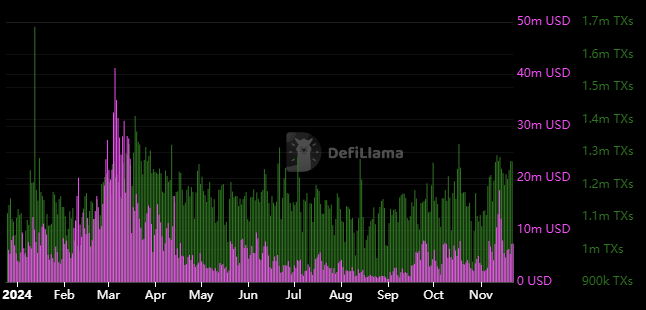
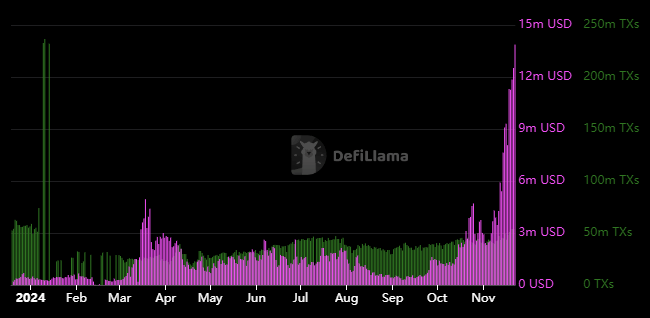
Despite being a latecomer, Solana has attracted a vibrant user community with a TVL of $8.9 billion. The Solana ecosystem is growing rapidly, with over 1 million active wallets and prominent applications such as Jito, Raydium, and Orca.
Solana’s transaction costs range from $0.002 to $0.05, which is much lower than Ethereum, where gas fees can reach $50 when the network is congested. While layer 2 solutions reduce costs on Ethereum, they add complexity for users.
Price Analysis and Growth Potential
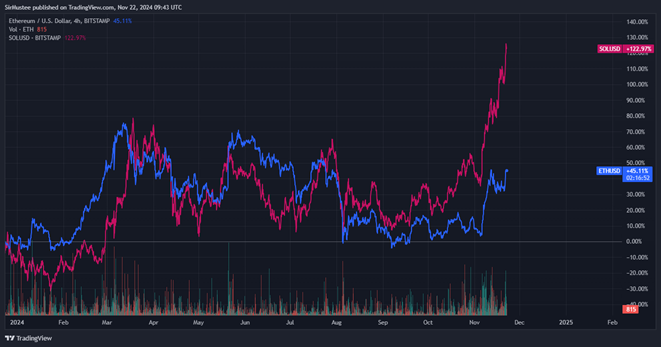
Ethereum increased 40% from $2,375 to $3,445 between November 5 and November 22, with a market cap of $407.18 billion. Meanwhile, Solana increased more than 70% from $154 to an all-time high of $265, with a market cap of $123.32 billion.
Based on RSI and MACD analysis, Ethereum’s growth potential in this cycle could reach 3x, while Solana could reach 5-7x.
Future Trend Prediction
Ethereum remains the top choice for institutional investors thanks to its stable and secure ecosystem. The approval of Ethereum ETFs has also contributed to the increase in value, with total current net assets reaching $9.77 billion.
Meanwhile, Solana is becoming the preferred choice for individual users thanks to its fast speed and low cost, especially in areas such as meme coin trading and blockchain gaming. If a Solana ETF is approved in the future, institutional capital could pour into this blockchain.
While Ethereum has advantages in decentralization and security, Solana scores in scalability and performance. If the market continues to prioritize speed and utility, Solana could emerge stronger in this cycle. However, in the long term, Ethereum remains a solid foundation for institutional-grade blockchain applications.
In short, Ethereum is a safe choice for long-term investors, while Solana offers the opportunity for rapid growth in the short term due to its popularity and superior performance. The competition between these two blockchains not only promotes the overall development of the industry but also brings many attractive investment opportunities in the future.